


Saka Cliff Manor Hiking Trail
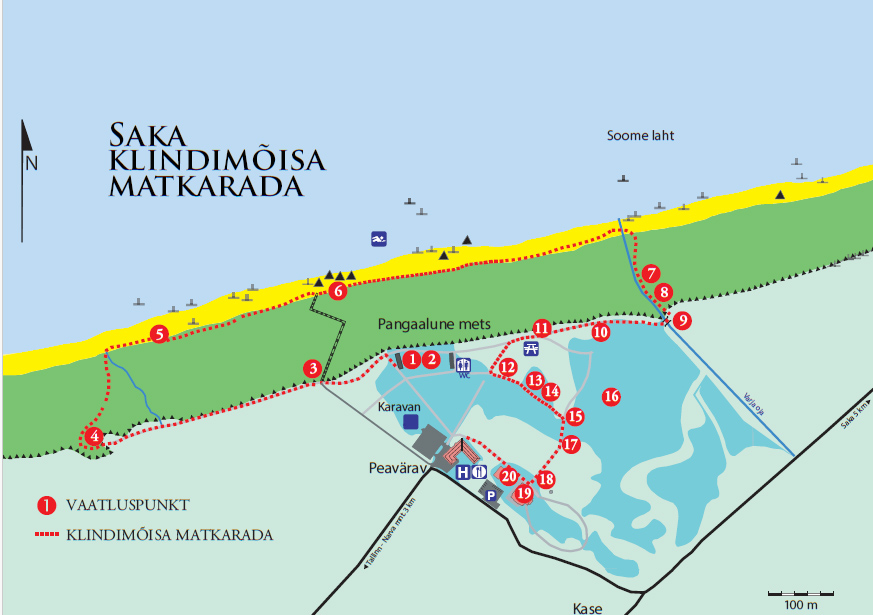
1. Sea Tower
Until 1992, Saka Manor was home to a Soviet border guard post. Since 2006, the former Soviet border guard searchlight building and watchtower have been open to visitors. In good weather, you can see Suursaari (Hogland) and the Tytärsaari Islands in the eastern Gulf of Finland, which belonged to Finland before the Winter War.
The atmosphere and complex history of these islands can also be felt inside the Sea Tower, where two seminar rooms are named after Hogland and Tytärsaari.The upper floors of the tower feature two exclusive accommodation units – the Sunset Suite and Klint Apartment. The staircase leading to them is lined with an exhibition introducing the Baltic Klint.
2. Memorial to the Baltic Germans Resettled in 1939–1941
Next to the tower stands Umsiedlung 1939–1941, a memorial created by the current owners of Saka Manor as a gift to mark the 100th anniversary of the Republic of Estonia. The memorial, dedicated to the departure of the Baltic Germans, was unveiled on 18 October 2018, exactly 79 years after the first ship carrying resettlers left the Port of Tallinn.
The bronze cranes created by sculptor Simson von Seakyl symbolise the more than 20,000 Baltic Germans who were forced to leave Estonia. People also departed from other parts of Livonia. From Riga alone, 38,000 Baltic Germans were resettled. With very little notice, these people had to leave behind homes built and cherished by generations, as well as most of their possessions. Taking their children, elderly family members and what little they could carry, they set out into an uncertain future that, for many, brought poverty and death. As far as is known, this is the only memorial in Estonia and Latvia dedicated to this controversial chapter of history, and possibly the only one of its kind in all of Eastern and Central Europe.
3. Staircase
Designed by architects Tiit Kaljundi and Ivo-Martin Veelma, the Saka staircase, with its 234 steps, was completed in 2007 and recognised as Estonia’s best small-scale architectural structure of the year. The staircase connects the top of the cliff with the sandy beach 48 metres below and is one of the few access points to the beach in this area.It consists of two sections connected by a boardwalk running through the forest below the cliff. From the top of the staircase, a hiking trail heading west also leads down to the beach along a relatively steep path.
NB! On 1 July 2026, Saka Manor reopened its staircase, which has a history spanning almost 20 years! Thousands of footsteps have travelled up and down these stairs – dreamers, holidaymakers, fishermen, romantics and adventurers. Come and rediscover the Saka staircase!
4. Cambrian Terrace
Continuing west from the staircase, we reach the Cambrian sandstone terrace, which is about 50 metres high and a couple of hundred metres wide. It is bordered by an escarpment rising up to 20 metres. The Cambrian sandstone is estimated to be around 530 million years old. From here, a narrow footpath continues down to the beach. This area is also home to one of the characteristic plants of the cliff forest – perennial honesty (Lunaria rediviva).
5. Blue Clay
The term Blue Clay was given to this type of clay in the 19th century by W. Strangways (b. 1821), an English diplomat and amateur geologist who worked in St Petersburg. At Saka, the Cambrian Blue Clay formation is nearly 80 metres thick. Blue Clay is the oldest sedimentary rock exposed in Estonia. It is also considered the oldest clay in the world, as no other clay of such an ancient age – approximately 565 million years – has retained the characteristic properties of clay. During the formation of the Blue Clay deposits, the Cambrian Explosion took place – a period of exceptionally rapid development and diversification of life forms on Earth.
6. Cliff Forest
The broad-leaved deciduous forest growing at the foot of the North Estonian Klint escarpment, in a belt ranging from a few dozen to several hundred metres in width, is known as cliff forest (Estonia clivosa). Cliff forests are among the few forest areas in Estonia where nature has remained largely untouched. In addition to elm, ash and alder, the forest may also include aspen, birch, linden, oak and other tree species.
7. Saka Waterfall System
At the eastern edge of the manor park, the Varja Stream descends over the 48-metre-high cliff escarpment, forming the three-tiered, 19-metre-high Saka, or Kivisilla, Waterfall System. The first tier is a 6-metre-high limestone escarpment exposing Middle Ordovician limestone. From there, the waterfall continues down a slope composed of Dictyonema shale and Obolus sandstone. The lower, 8-metre-high tier consists of Cambrian sandstone.
8. Ladder Staircase
Hikers can climb from the forest below the cliff to the top of the escarpment using the steep ladder staircase on the eastern side of the waterfall canyon. This almost vertical staircase was built on the same site as the former ladder once used by Soviet border guard patrols.
9. Saka Cliff
The staircase brings you to Saka Cliff. Saka Cliff forms part of the largest structural unit of the North Estonian Klint – the nearly 20-kilometre-long Saka–Ontika–Toila Klint Plateau, which extends as far as the Pühajõgi Valley. To the west, the plateau is bordered by the Moldova–Aa Klint Bay, beginning near Saka Manor, and to the east by the Toila Klint Bay. Within the Saka–Ontika–Toila Klint Plateau, four smaller structural units can be distinguished east of Saka Cliff: Ontika, Valaste, Martsa and Toila cliffs. As part of the Saka–Ontika–Toila Klint Plateau, Saka Cliff was nominated, together with six other remarkable North Estonian cliffs, for inclusion on the UNESCO World Heritage List, but the nomination did not receive the support of the UNESCO World Heritage Committee.
10. Mathias Rust Memorial
This runway-shaped memorial was unveiled on 28 May 2022, marking 35 years since the day when 18-year-old German pilot Mathias Rust flew over this area in his Cessna 172 light aircraft on his way to Moscow, where he landed near the Kremlin walls by Red Square. This historic flight contributed to the processes that ultimately led to the dissolution of the Soviet Union and the restoration of Estonia’s independence, as well as the dissolution of the Warsaw Pact, the collapse of communist regimes in Eastern Europe, and the withdrawal of Soviet troops from Afghanistan.
11. Kõrtsimäe Cliff
Kõrtsimäe Cliff is part of Saka Cliff. In the past, the main postal road to Narva ran across it. The cliff takes its name from an inn that once stood here. Its former location is marked by the limestone ruins south of the road.
12. “Kalev’s Arrival” Memorial
This eagle sculpture, created by sculptor Lembit Kiisson more than 40 years ago, was erected in Saka Manor Park on 19 October 2022. The idea for the memorial comes from the Estonian national epic Kalevipoeg. In its opening story, “Kalev’s Arrival, Salme and Linda, The Wedding”, Kalev is described as arriving on the high coast of Virumaa on the back of an eagle. What better place could there be for this epic legend than the top of Saka Cliff?
13. Open-Air Stage
The 400-seat open-air stage was built in a former gravel pit, which provided an ideal setting for an amphitheatre-style venue. For decades, the Soviet military had also used the site to dump waste, so the area was in need of extensive clean-up. On 12 June 2010, the Virumaa Song Festival was held here. The event is commemorated by a limestone song pillar erected beside the open-air stage.
14. Bunker Hill
The bunker, shelters and connecting trenches date from the period after World War II, when a Soviet border guard post was located at Saka Manor. During World War II, the manor housed a German military unit (intelligence school), of which the foundations of the barracks still remain. After the war, the manor was used as a pioneer camp and later as dormitories for the builders of the V. I. Lenin Oil Shale Processing Plant, constructed as a Komsomol project. From the late 1950s until 1992, the manor housed a Soviet border guard post and barracks.
15. Stone Exhibition
The stone exhibition, entitled “The Garden Path”, is located on six irregularly shaped granite platforms. It consists of decorative stone monoliths arranged according to their geological age and the upward slope of the path. The exhibition ranges from 1.9-billion-year-old Palaeoproterozoic rocks to 425-million-year-old Silurian rocks. Each group of rocks is accompanied by an information panel with a brief description.
16. Black Poplar
The black poplar (Populus nigra ssp. betulifolia) is the most remarkable tree in Saka Manor Park in terms of its size. Its trunk diameter, measured at a height of 1.3 metres, is 146 cm.
17. Manor Park
The systematic landscaping of Saka Manor Park began in the second half of the 19th century, alongside the construction of the new manor house. The park is dominated by native tree species of various ages, including oak, linden, maple, elm, pine, spruce and silver birch. More exotic species include Siberian and European larch, horse chestnut and arborvitae (Thuja).
18. Manor House
Suur-Saka (Gross-Sack), also known as Sackhof Manor, was established in the 17th century after King Gustav II Adolf of Sweden granted the lands in 1626 to Jürgen (Jöran) Leslie, who came from Aberdeen, Scotland.
The manor acquired its present appearance during the ownership of the Löwis of Menar family, also of Scottish origin, who owned the estate from 1809 until the land reform of 1920. Although both the first and the last owners of Saka Manor had Scottish roots, the Neo-Renaissance manor house, built between 1862 and 1864, is more representative of Italian Renaissance architecture and differs considerably from most Estonian manor houses.
After the last manor owners left for Germany on 2 November 1939, Saka became a military site. Its strategic location high above the Gulf of Finland made it an ideal base for both coastal artillery batteries and border surveillance. At different times, the manor was used by the armed forces of three countries: an Estonian coastal defence battery, a Waffen-SS unit from 1941 to 1944, and, with some interruptions, Soviet border guards until 1992.
After the Soviet military left in 1992, Saka Manor remained abandoned until 2001, when the ruined and looted estate was purchased by the Kaasik family at a public auction organised by the state.
The restoration of the main building was completed in autumn 2010, marking the end of almost ten years of restoration work on the entire Saka Manor complex.
Saka Manor – the pearl of the North Estonian Klint – is one of the few manor complexes in Estonia to have been restored in its entirety.
19. “From Generation to Generation” Sculpture
The “From Generation to Generation” sculpture (sculptor Simson von Seakyl), located in front of the manor house, is dedicated to the 400th anniversary of the first recorded mention of Saka Manor. The coats of arms of three families closely connected with Saka Manor – the Leslies (1620–1748), the Löwis of Menars (1809–1939), and the Kaasik family, who restored the manor in 2010 – symbolise the story of Saka Manor through four centuries. The memorial was unveiled on 8 June 2021.
20. Winter Garden
The Winter Garden at Saka Manor was completed in spring 2024. Until then, the largest hall in the manor complex could accommodate fewer than 100 people, limiting Saka’s development as a venue for cultural events and conferences. The Winter Garden accommodates 150 concert guests year-round. During the summer season, the spacious terraces increase its capacity to up to 200 guests.
Join the newsletter